03
how we write
Our writing style values clarity over sounding smart. We favor direct language, thoughtful pacing, and ideas that unfold with intention. What stays out is just as important as what goes in.
how we bring the voice to life
Good writing isn’t decoration. It’s how people understand what we mean.
Our voice should feel like a person who knows what they’re talking about — calm, sure, and kind.
Prioritize clarity, compassion, and consistency. Use the Associated Press (AP) Stylebook for grammar and punctuation, let threshold’s tone guide your judgment.
titles & capitalization
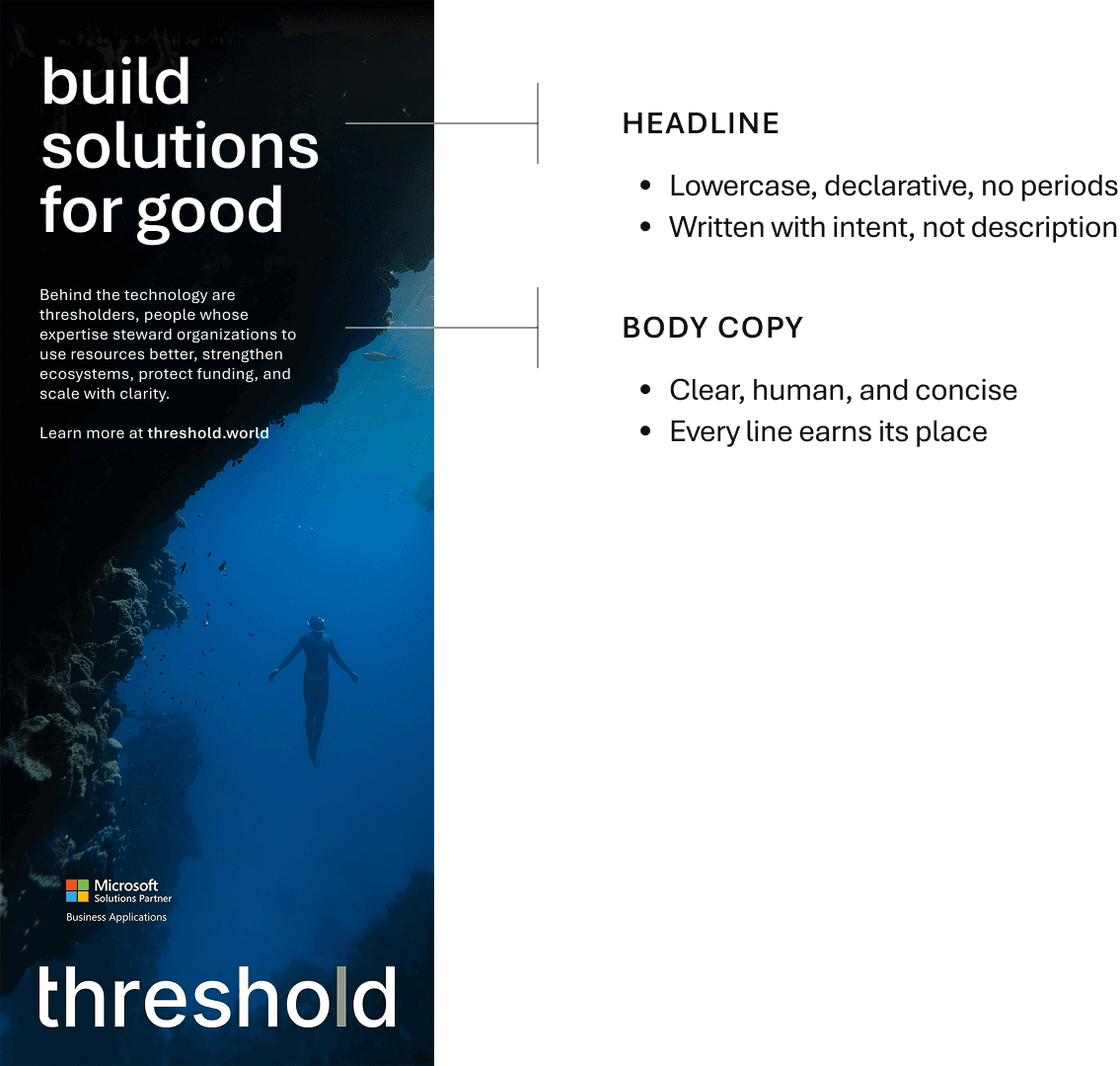
Headlines are lower case as a nod to humility and with no ending period.
Use sentence case for most writing — sub headlines, body copy.
Body copy is written normal. Capitalized and ending periods.
headlines
Headlines should carry energy. They should move, not just describe. Avoid slogans. Avoid filler. A good headline feels like it was written by someone who is committed to what they are declaring.
body copy
Write the way you’d explain something to someone smart but busy. Respect their time.
Keep it simple without dumbing it down. Every line should be necessary.
bullet points
Use bullet points when you need clarity fast. They’re for steps, requirements, options, and takeaways. Keep them consistent in structure:
Start with the keyword
One idea per bullet
Punctuation follows structure:
Full sentences end with a period.
Fragments don’t end with a period.
writing principles
be clear, not clever & keep the noise out
We write so people get it the first time. Clear isn’t boring, it’s confident. If your audience has to decode your meaning, you’ve lost them. Anyone can make things sound smart. Few can make them easy to understand.
we talk like people, not platforms
Write in your own voice. If it reads like it was generated, rewrite it until it sounds like a human being.
Example:
✔️ We build tools that help teams do more good, faster.
❌ It’s not just a platform, it’s a powerful, innovative solution designed to seamlessly empower mission driven organizations at scale — unlocking clarity, driving meaningful outcomes, and transforming the way teams operate in today’s fast paced world.
simplicity over sophistication
Clarity earns trust.
Choose the simplest, most direct words that communicate what you mean.
Example:
✔️ Use not utilize
✔️ Start not initiate
✔️ Help not facilitate
write in active voice
We lead with people and action.
Use the active voice whenever possible, it brings clarity and ownership to our message. Echos our non-negotiable commitment.
Example:
✔️ threshold empowers nonprofits to move faster.
❌ Nonprofits are empowered by threshold.
use space with purpose, clarity needs air
Language is part of our system.
Pacing, spacing, and silence matter. Whitespace is part of the message. Good rhythm guides attention without decoration: with intention, space, and reason.
punctuation
Keep it light. Use periods more than commas. It gives space for thought.
sentence length
A sentence should carry one thought. If it starts to do more, break it. Give people space to think.
jargon
Skip it. If it sounds like something only a PowerPoint would say, leave it out. We can talk about complex things simply. That’s what clarity is for.
writing guidelines, editorial style, writing principles, brand writing, clarity, concise language, plain language, human tone, structured communication, headlines, subheads, formatting rules, grammar standards, punctuation, readability, active voice, avoid jargon, intentional language, internal communications, external communications, content standards, messaging framework
03
how we write
Our writing style values clarity over sounding smart. We favor direct language, thoughtful pacing, and ideas that unfold with intention. What stays out is just as important as what goes in.
how we bring the voice to life
Good writing isn’t decoration. It’s how people understand what we mean.
Our voice should feel like a person who knows what they’re talking about — calm, sure, and kind.
Prioritize clarity, compassion, and consistency. Use the Associated Press (AP) Stylebook for grammar and punctuation, let threshold’s tone guide your judgment.
titles & capitalization
Headlines are lower case as a nod to humility and with no ending period.
Use sentence case for most writing — sub headlines, body copy.
Body copy is written normal. Capitalized and ending periods.
headlines
Headlines should carry energy. They should move, not just describe. Avoid slogans. Avoid filler. A good headline feels like it was written by someone who is committed to what they are declaring.
body copy
Write the way you’d explain something to someone smart but busy. Respect their time.
Keep it simple without dumbing it down. Every line should be necessary.
bullet points
Use bullet points when you need clarity fast. They’re for steps, requirements, options, and takeaways. Keep them consistent in structure:
Start with the keyword
One idea per bullet
Punctuation follows structure:
Full sentences end with a period.
Fragments don’t end with a period.
writing principles
be clear, not clever & keep the noise out
We write so people get it the first time. Clear isn’t boring, it’s confident. If your audience has to decode your meaning, you’ve lost them. Anyone can make things sound smart. Few can make them easy to understand.
we talk like people, not platforms
Write in your own voice. If it reads like it was generated, rewrite it until it sounds like a human being.
Example:
✔️ We build tools that help teams do more good, faster.
❌ It’s not just a platform, it’s a powerful, innovative solution designed to seamlessly empower mission driven organizations at scale — unlocking clarity, driving meaningful outcomes, and transforming the way teams operate in today’s fast paced world.
simplicity over sophistication
Clarity earns trust.
Choose the simplest, most direct words that communicate what you mean.
Example:
✔️ Use not utilize
✔️ Start not initiate
✔️ Help not facilitate
write in active voice
We lead with people and action.
Use the active voice whenever possible, it brings clarity and ownership to our message. Echos our non-negotiable commitment.
Example:
✔️ threshold empowers nonprofits to move faster.
❌ Nonprofits are empowered by threshold.
use space with purpose, clarity needs air
Language is part of our system.
Pacing, spacing, and silence matter. Whitespace is part of the message. Good rhythm guides attention without decoration: with intention, space, and reason.
punctuation
Keep it light. Use periods more than commas. It gives space for thought.
sentence length
A sentence should carry one thought. If it starts to do more, break it. Give people space to think.
jargon
Skip it. If it sounds like something only a PowerPoint would say, leave it out. We can talk about complex things simply. That’s what clarity is for.
writing guidelines, editorial style, writing principles, brand writing, clarity, concise language, plain language, human tone, structured communication, headlines, subheads, formatting rules, grammar standards, punctuation, readability, active voice, avoid jargon, intentional language, internal communications, external communications, content standards, messaging framework
03
how we write
Our writing style values clarity over sounding smart. We favor direct language, thoughtful pacing, and ideas that unfold with intention. What stays out is just as important as what goes in.
how we bring the voice to life
Good writing isn’t decoration. It’s how people understand what we mean.
Our voice should feel like a person who knows what they’re talking about — calm, sure, and kind.
Prioritize clarity, compassion, and consistency. Use the Associated Press (AP) Stylebook for grammar and punctuation, let threshold’s tone guide your judgment.
titles & capitalization
Headlines are lower case as a nod to humility and with no ending period.
Use sentence case for most writing — sub headlines, body copy.
Body copy is written normal. Capitalized and ending periods.
titles & capitalization
Headlines are lower case as a nod to humility and with no ending period.
Use sentence case for most writing — sub headlines, body copy.
Body copy is written normal. Capitalized and ending periods.
headlines
Headlines should carry energy. They should move, not just describe. Avoid slogans. Avoid filler. A good headline feels like it was written by someone who is committed to what they are declaring.
headlines
Headlines should carry energy. They should move, not just describe. Avoid slogans. Avoid filler. A good headline feels like it was written by someone who is committed to what they are declaring.
body copy
Write the way you’d explain something to someone smart but busy. Respect their time.
Keep it simple without dumbing it down. Every line should be necessary.
body copy
Write the way you’d explain something to someone smart but busy. Respect their time.
Keep it simple without dumbing it down. Every line should be necessary.
bullet points
Use bullet points when you need clarity fast. They’re for steps, requirements, options, and takeaways. Keep them consistent in structure:
Start with the keyword
One idea per bullet
Punctuation follows structure:
Full sentences end with a period.
Fragments don’t end with a period.
bullet points
Use bullet points when you need clarity fast. They’re for steps, requirements, options, and takeaways. Keep them consistent in structure:
Start with the keyword
One idea per bullet
Punctuation follows structure:
Full sentences end with a period.
Fragments don’t end with a period.
writing principles
be clear, not clever & keep the noise out
We write so people get it the first time. Clear isn’t boring, it’s confident. If your audience has to decode your meaning, you’ve lost them. Anyone can make things sound smart. Few can make them easy to understand.
we talk like people, not platforms
Write in your own voice. If it reads like it was generated, rewrite it until it sounds like a human being.
Example:
✔️ We build tools that help teams do more good, faster.
❌ It’s not just a platform, it’s a powerful, innovative solution designed to seamlessly empower mission driven organizations at scale — unlocking clarity, driving meaningful outcomes, and transforming the way teams operate in today’s fast paced world.
simplicity over sophistication
Clarity earns trust.
Choose the simplest, most direct words that communicate what you mean.
Example:
✔️ Use not utilize
✔️ Start not initiate
✔️ Help not facilitate
write in active voice
We lead with people and action.
Use the active voice whenever possible, it brings clarity and ownership to our message. Echos our non-negotiable commitment.
Example:
✔️ threshold empowers nonprofits to move faster.
❌ Nonprofits are empowered by threshold.
use space with purpose,
clarity needs air
Language is part of our system.
Pacing, spacing, and silence matter. Whitespace is part of the message. Good rhythm guides attention without decoration: with intention, space, and reason.
use space with purpose,
clarity needs air
Language is part of our system.
Pacing, spacing, and silence matter. Whitespace is part of the message. Good rhythm guides attention without decoration: with intention, space, and reason.
punctuation
Keep it light. Use periods more than commas. It gives space for thought.
sentence length
A sentence should carry one thought. If it starts to do more, break it. Give people space to think.
jargon
Skip it. If it sounds like something only a PowerPoint would say, leave it out. We can talk about complex things simply. That’s what clarity is for.
writing guidelines, editorial style, writing principles, brand writing, clarity, concise language, plain language, human tone, structured communication, headlines, subheads, formatting rules, grammar standards, punctuation, readability, active voice, avoid jargon, intentional language, internal communications, external communications, content standards, messaging framework